How to start with an LED face mask: your first 4 weeks
A practical plan for your first 4 weeks with an LED face mask: what to do before the first use, how to set intensity and frequency, and how to photograph your skin and keep a journal to track changes.

Updated: November 2026 · Marek Švajka · 7 min read
Start with a patch test on the skin of your arm, then use the LED face mask for 10 minutes on clean, dry skin 3 to 5 times a week, keeping the intensity lower in the first week. Track changes with photos taken in the same light, angle and time of day plus a short journal – the pace of change is different for everyone.
At a glance
- Before the first use, charge the mask (4–5 hours) and do a patch test on your arm.
- In week one, start with a lower intensity and three 10-minute sessions.
- From week two, pick a fixed time in your routine and gradually move to 3–5 sessions a week.
- Photograph your skin before you start, then always in the same light, angle and time of day.
- Studies assessed the skin after 4 to 16 weeks – the pace of change is individual and not a promise.
How do you start with an LED face mask and track changes?
Take it easy: the first four weeks are mostly about making the LED mask a natural part of your routine. Set a realistic plan, start at a lower intensity, log each session and take a photo of your skin once a week under the same conditions.
With LED light, consistency matters more than one long session. The LumenLuxe LED mask makes this easy – a session takes 10 minutes and the mask then switches itself off, so it fits in while you read in the evening or enjoy a cup of tea.
What should you do before using an LED mask for the first time?
Before the first session, fully charge the mask, read the instructions and do a patch test on the skin of your arm. These steps take only a moment and give you confidence that you are starting the right way.
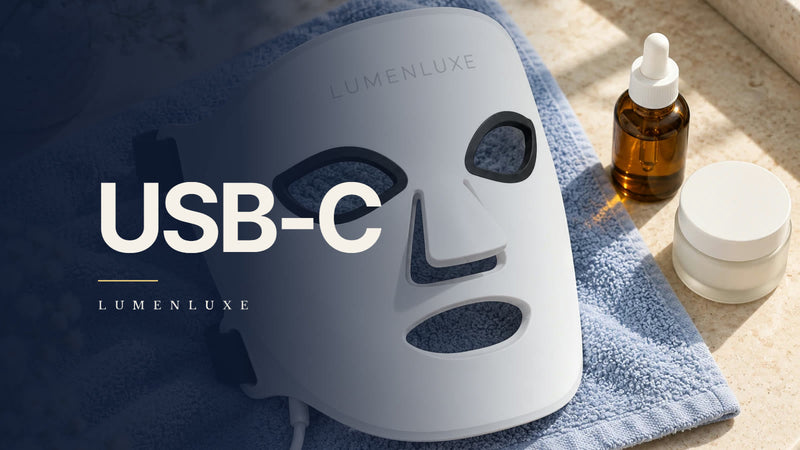
- Charging – a full charge via USB-C takes 4–5 hours, and one charge lasts for about 10 sessions.
- Patch test – place the mask on the inside of your forearm and switch it on at a lower intensity. Mild redness fades within 1–2 hours; if you feel a burning sensation, stop immediately.
- Eye shields – you will find them in the box and use them in every session.
- Skincare – move retinol and acids to a different time of day than the LED mask.
Who should not use an LED mask?
The following guidelines apply to all LED masks and are part of using them correctly. It is worth reading them before your first session. Do not use an LED mask in case of:
- pregnancy,
- light-sensitive epilepsy,
- an active skin condition or infection in the area to be treated,
- retinal disorders,
- taking photosensitising medication (e.g. isotretinoin, some antibiotics).
Use light-sensitising skincare (retinol, acids) at a different time of day than the LED mask. Before the first use, do a patch test on your arm – mild redness fades within 1–2 hours; if you feel a burning sensation, stop immediately. If you are unsure, talk to a doctor. You will find details in the article LED mask contraindications: who should not use it.
What does a plan for the first 4 weeks with an LED mask look like?
The simplest approach is to start with three sessions a week at a lower intensity and gradually move to 3–5 sessions a week at a setting that feels comfortable for your skin. The table shows a guideline.
| Week | Sessions with the LumenLuxe LED mask | Intensity | Focus |
|---|---|---|---|
| 1 | 3× 10 min | lower (1–2 of 5) | patch test, first skin photos, start a journal |
| 2 | 3–4× 10 min | gradually higher, as your skin feels | a fixed time in your routine (morning or evening) |
| 3 | 3–5× 10 min | the level that suits you | a steady rhythm, optionally try another mode |
| 4 | 3–5× 10 min | same setting | photos under the same conditions, a short journal review |
If your skin is more sensitive, stay at a lower intensity for longer – you set the pace. The best time of day for a session is covered in the article LED mask in the morning or evening: the order of steps in your routine.
How does a single session work, step by step?
A session takes 10 minutes and is done on clean, dry skin without make-up. The steps are always the same:
- Remove make-up and cleanse – make-up and SPF cream form a layer that lets less light through.
- Pat your skin dry – save rich creams or oils for afterwards.
- Put on the eye shields, close your eyes and put on the mask.
- Choose a mode and intensity – the red 630 nm mode is a good place to start.
- After 10 minutes the mask switches off automatically; then apply a serum and moisturiser.
- Log the session in your journal – one line is enough.
How should you photograph your skin so changes can be compared?
Photos can only be compared if you always take them under the same conditions: in the same light, from the same angle and at the same time of day. Otherwise, a difference in lighting can easily hide or exaggerate what is really happening on your skin.
- Light – shoot by a window in daylight or always by the same lamp, without flash or filters.
- Angle – front and both sides, with your phone at eye level and at the same distance.
- Time – for example, always in the morning after cleansing, before cream and make-up.
- Expression and background – neutral face, hair tied back, the same background.
- Regularity – one set before your first session, then once a week on the same day.
How to keep a simple skincare journal
A journal helps you stay consistent and later understand what works for your skin. A short table on your phone or in a notebook is enough:
| Date | Mode | Intensity | How the skin felt | Note |
|---|---|---|---|---|
| 3 Nov | red 630 nm | 2 of 5 | calm, comfortable | evening after a shower |
| 5 Nov | red 630 nm | 2 of 5 | soft, hydrated | new serum in the morning |
Also note changes in your other skincare, your sleep or busier periods – they affect how your skin looks too.
After how long did studies assess skin changes?
Studies with LED light most often assessed the skin after 4 to 16 weeks of regular use. This is not a promise of results – the pace of change is individual and depends on your skin, consistency and overall skincare.
| Study | Wavelengths | Participants and regimen | When assessed |
|---|---|---|---|
| Mota et al., 2023 | 660 nm and 590 nm | 137 women, 10 sessions | after 4 weeks |
| Mineroff et al., 2023 | 633/830/1072 nm | 7 men, 3–5× a week | after 6 weeks |
| Couturaud et al., 2023 | 630 nm | 20 women, 12 min twice a week | after 3 months |
| Park et al., 2025 | 630 nm + 850 nm | 60 adults | at weeks 8, 12 and 16 |
Mota et al. (2023): 10 sessions over 4 weeks
The study included 137 women aged 40–65; one half of the face received 660 nm light and the other 590 nm, for a total of 10 sessions over 4 weeks. The volume of wrinkles around the eyes, measured with a VisioFace RD device, decreased by 31.6% at 660 nm and by 29.9% at 590 nm. The authors did not describe the home device in detail, and a critical letter was later published about the study (PMID 37252792) (DOI 10.1089/photob.2022.0114).
The cited studies tested other devices and wavelengths; their results are not results of the LumenLuxe mask.
Mineroff et al. (2023): a home mask over 6 weeks
Seven men used a home mask with wavelengths of 633, 830 and 1072 nm 3 to 5 times a week for 6 weeks. The authors reported a significant improvement in wrinkles and brown spots; pores and UV spots did not change significantly (PubMed 37418018).
The cited studies tested other devices and wavelengths; their results are not results of the LumenLuxe mask.
Couturaud et al. (2023): 630 nm over three months
Twenty women used a home mask with a wavelength of 630 nm for 12 minutes twice a week for three months. The authors described improvements in wrinkle depth, firmness, dermal density and pores. The study had no control group, and its authors were employees of the manufacturer of the tested mask (PubMed 37522497).
The cited studies tested other devices and wavelengths; their results are not results of the LumenLuxe mask.
Park et al. (2025): follow-up over 16 weeks
This randomised, double-blind, sham-controlled study took place at two centres and included 60 adults who used a home mask with wavelengths of 630 nm and 850 nm for 16 weeks. An improvement in wrinkles around the eyes was recorded at weeks 8, 12 and 16 (PMC11835066).
The cited studies tested other devices and wavelengths; their results are not results of the LumenLuxe mask.
The practical takeaway: treat the first four weeks as a warm-up and compare your photos over a longer period.
Which mistakes should you avoid at the start?
The most common things that happen at the start are irregular sessions, skin that has not been fully cleansed, or trying to speed things up with longer sessions. With light, the right dose and consistency are what count.
- Skipping sessions – a fixed time and a phone reminder help.
- Using the mask over make-up or SPF cream – skin should be clean and dry.
- Extending sessions beyond 10 minutes – the automatic shut-off keeps the right timing for you.
- Retinol or acids right before the mask – they belong at a different time of day.
- Comparing photos taken in different light – always the same light, angle and time.
They are covered in more detail in the article Why your LED mask isn’t working: 7 common mistakes.
LumenLuxe LED mask at a glance
CE · RoHS7 modes
A good start needs a session that easily becomes a habit. The LumenLuxe LED mask is built for exactly that: 10 minutes with automatic shut-off and five intensity levels, so you can begin gently and build up at your own pace.
| Parameter | LumenLuxe LED mask |
|---|---|
| Session | 10 minutes, 3–5× a week, automatic shut-off |
| Power and dose | 20 mW/cm², 5 intensity levels, ≈ 12 J/cm² per 10 min at maximum intensity |
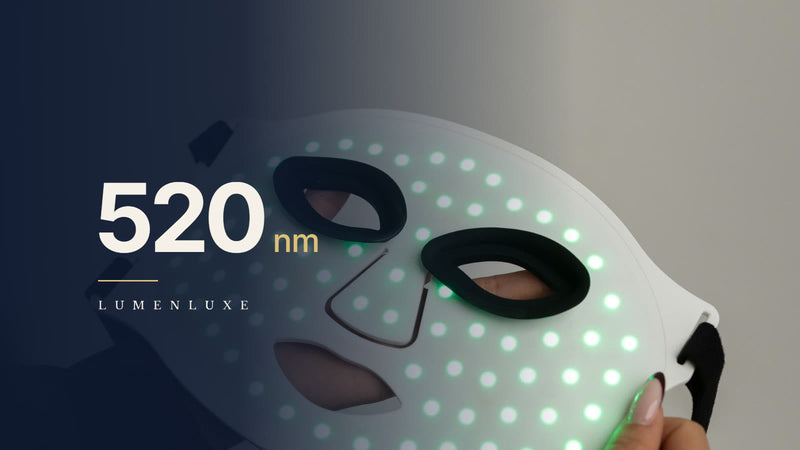
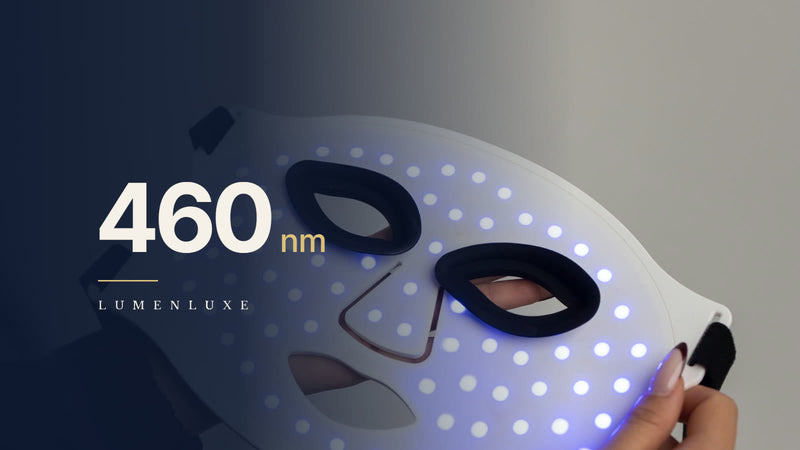
| Modes | 7 – red 630 nm, blue 460 nm, green 520 nm, purple 630 + 460, yellow 630 + 520, cyan 520 + 460, white 630 + 520 + 460 |
| Number of LEDs | 210 |
| Battery | USB-C, 1,200 mAh, 4–5 h charging, about 10 sessions per charge |
| Certification | CE and RoHS |
| Warranty and returns | 24-month warranty, 60-day returns |
| Price | €199.97 |
BENEFITS
- ✓ 5 intensity levels for a gentle start and a clearly stated power of 20 mW/cm²
- ✓ 10-minute session with automatic shut-off that fits easily into your day
- ✓ 7 modes – start with red 630 nm and explore the others step by step
- ✓ Cordless with USB-C charging, about 10 sessions per charge
- ✓ Eye shields and a storage bag included in the box
- ✓ 24-month warranty and 60-day returns
Frequently asked questions
How often should you use an LED mask at the start?
In the first week, three 10-minute sessions are enough. After that you can gradually move to 3–5 sessions a week, which is the recommended rhythm for the LumenLuxe LED mask.
Which intensity should you choose for the first use?
Start at a lower level, for example 1 or 2 of 5. If your skin stays calm, you can gradually increase the intensity over the following weeks, depending on what feels comfortable.
When will I see changes in my skin?
The pace of change is individual and depends on your skin, consistency and the rest of your skincare. Studies assessed the skin after 4 to 16 weeks, but this is not a promise – which is why it pays to photograph your skin under the same conditions and keep a journal.
Is it normal for skin to be slightly red after a session?
Mild redness after a session usually fades within 1–2 hours. If you feel a burning sensation, stop the session immediately and use a lower intensity next time, or talk to a doctor.
Can I use the LED mask straight out of the box?
First charge it fully via USB-C, which takes 4–5 hours, and do a patch test on your arm. Then you can start your first 10-minute session with the eye shields on.
Conclusion: how to make the LED mask a habit
The best start is a simple one: a patch test, a lower intensity, a fixed time in your routine and skin photos under the same conditions. The first four weeks give you a rhythm you can build on. The LumenLuxe LED mask makes it easy with a 10-minute session, automatic shut-off and five intensity levels – and with 60 days to return it, you can try it at home without any pressure.
Start with the LumenLuxe LED maskMorning or evening?
Related: How to Clean and Charge an LED Face Mask: Care Guide